
W.P.V Wayfinder
The WayCorp Planetary Vehicle (W.P.V.) Wayfinder is a heavily modified six-wheeled all-terrain exploration vehicle carried aboard the W.E.V. Ascendant. Designed for extended planetary reconnaissance missions, the Wayfinder serves as a mobile command center, scientific laboratory, emergency shelter, and armored transport capable of operating in some of the harshest environments known to humanity.
Built to support small exploration teams during first-contact surveys, archaeological expeditions, and hazardous environmental investigations, the Wayfinder embodies WayCorp’s philosophy that knowledge is best gathered up close.
While its official role is scientific exploration, the vehicle incorporates numerous defensive systems and survival features that allow its crew to operate independently for extended periods beyond The Reach of immediate support.
Design
The Wayfinder is a rugged six-wheeled vehicle built around a reinforced pressure-sealed hull capable of surviving extreme environments. Its suspension system allows it to traverse rocky terrain, steep inclines, volcanic fields, frozen wastelands, and unstable alien landscapes while maintaining crew safety and equipment integrity.
The vehicle’s armored shell provides protection agains, Radiation storms, Micrometeorite impacts, Toxic atmospheres, Extreme pressure differentials, Small-arms fire and extreme temperatures
Although not intended for frontline military operations, the vehicle’s protective systems have proven more than adequate during encounters with pirates, hostile fauna, and dangerous environmental hazards. May organizations across The Reach tried to copy its design, but more resort to buying the commercial version of the Wayfinder the "Wayfinder" CC32.
Scientific Facilities
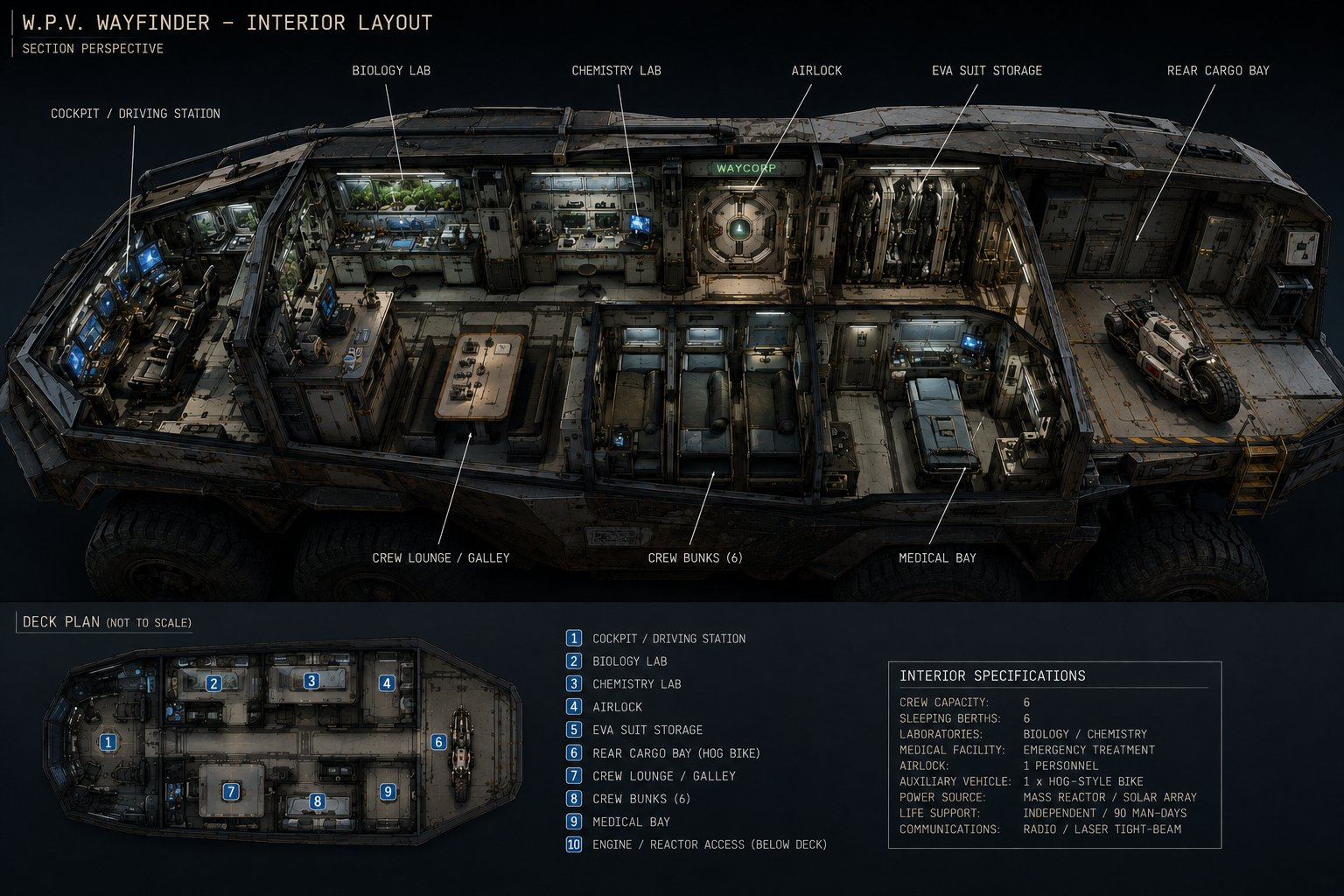
A major portion of the vehicle’s internal volume is dedicated to scientific operations. The onboard biology laboratory allows exploration teams to analyse native organisms, preserve biological samples, conduct genetic sequencing, and safely contain potentially hazardous specimens. Adjacent to this facility is a fully equipped chemistry laboratory capable of examining atmospheric composition, testing water quality, identifying mineral deposits, evaluating toxicity levels, and assessing the usefulness of local resources.
Together, these laboratories allow researchers to perform detailed planetary surveys without the delays associated with returning samples to the mothership. For many newly discovered worlds, the first detailedscientific reports are often produced entirely within the confines of a Wayfinder.
Medical Facilities
The vehicle includes a compact but capable medical bay designed to stabilize injured personnel and treat common expedition-related emergencies. Radiation exposure, toxic contamination, fractures, trauma injuries, and environmental hazards can all be addressed within the facility. While the medical bay lacks the equipment necessary for major surgical procedures, it is more than sufficient to keep a patient alive until evacuation to the mothership or another medical installation can be arranged.
Crew Accommodations
Despite its scientific focus, the Wayfinder is intended to function as a temporary home for its crew during surface expeditions. Six tightly arranged bunks provide sleeping quarters, while storage compartments throughout the vehicle carry food, water, spare equipment, medical supplies, and other essential consumables. Under standard operating conditions the vehicle can sustain a full complement of six crew members for approximately fifteen days, providing a total endurance of ninety man-days before resupply becomes necessary.
While conditions aboard are often described as cramped, most explorers agree that the discomfort is a small price to pay for the freedom of operating far beyond The Reach of established settlements.
Exploration Systems
The Wayfinder’s sensor suite is specifically designed for planetary reconnaissance and scientific survey work. Ground-penetrating scanners can reveal subterranean structures and mineral deposits, while atmospheric monitoring equipment continuously evaluates environmental conditions. Geological sensors, life-sign detectors, and topographical mapping systems work in concert to generate detailed survey data as the vehicle moves across the landscape.
These capabilities allow exploration teams to identify resource-rich regions, map previously unknown territory, locate potential hazards, and detect signs of both native life and ancient civilizations.
Power Systems
The Wayfinder is designed to remain operational for extended periods far from established infrastructure and therefore incorporates multiple redundant power systems. Its primary source of energy is a compact WayCorp Mass Reactor housed within a heavily shielded compartment beneath the vehicle’s central chassis. The reactor provides power for propulsion, scientific equipment, communications, environmental systems, laboratory operations, and defensive systems, allowing the vehicle to function independently even in the most remote regions of explored space.
Under normal operating conditions, the reactor requires refueling approximately once every three months. Intensive use of high-energy systems, particularly the particle-beam turret, advanced sensor arrays, and laboratory equipment, can reduce this endurance considerably, with some missions requiring refueling after only a single month of continuous operation.
To supplement the reactor and provide additional resilience, the vehicle’s upper hull is covered by a retractable solar collection array. While incapable of powering the vehicle’s propulsion systems on its own, the array is more than sufficient to sustain life-support equipment, communications systems, environmental controls, and emergency lighting. Energy gathered from the panels is stored within a bank of high-capacity emergency batteries, allowing critical systems to continue functioning even in the event of a reactor shutdown.
This layered approach to power generation ensures that a stranded Wayfinder can remain habitable for extended periods while awaiting rescue. WayCorp engineers often note that the vehicle was designed with a simple philosophy in mind: losing mobility is unfortunate, but losing life support is unacceptable.
Communications
Maintaining contact with orbit is considered essential during planetary operations, and the Wayfinder carries multiple communication systems to ensure that connection remains available. Conventional radio systems handle routine communications and local coordination, while a sophisticated laser tight-beam communications array provides secure long-distance transmission.
Unlike traditional broadcasts, the laser communication system projects a focused signal directly toward a designated receiver, making interception extremely difficult. This allows the transmission of scientific findings, strategic intelligence, and emergency reports with a level of security rarely available to surface expeditions.
Airlock and EVA Operations
A dedicated airlock chamber allows crew members to safely enter and exit hostile environments without compromising the integrity of the vehicle’s internal atmosphere. Adjacent storage lockers contain a full complement (6) of environmental suits, radiation-protection equipment, scientific sampling gear, and emergency survival kits. This arrangement allows field teams to deploy rapidly while ensuring that all necessary equipment remains close at hand.
Auxiliary Reconnaissance Vehicle
Housed within the rear cargo section is a compact four-wheeled reconnaissance buggy used for scouting operations. The smaller vehicle can access terrain unsuitable for the larger Wayfinder and is frequently employed for rapid surveys, sample retrieval missions, courier duties, and emergency extractions. During extended expeditions it often serves as the crew’s first means of investigating locations that have been identified by the main vehicle’s sensor systems.
Defensive Systems
Although officially classified as an exploration platform, the Wayfinder incorporates several defensive features intended to protect its crew in dangerous situations. The most notable of these is a concealed particle-beam turret hidden beneath a retractable armored dome on the vehicle’s roof. Normally invisible when stowed, the turret can be deployed within seconds to provide defensive fire against hostile forces.
WayCorp regulations restrict the weapon’s use to self-defense and the protection of personnel. Nevertheless, the existence of the system has saved numerous exploration teams from pirates, raiders, hostile wildlife, and other unforeseen threats encountered on the frontier.
Operational Role
The W.P.V. Wayfinder serves as the primary planetary exploration vehicle aboard the W.E.V. Ascendant and is expected to participate in first-contact surveys, archaeological investigations, resource assessment missions, search-and-rescue operations, and hazardous environment studies. Combining scientific capability, mobility, survivability, and defensive strength within a single platform, it is regarded by many explorers as the ideal companion for journeys into the unknown.
Among WayCorp crews, a popular saying has emerged regarding the vehicle:
“If you can reach it, the Wayfinder can get you there. If the Wayfinder can’t get you there, you probably shouldn’t go.”



This is actually really cool :) Well done.