Prologue
A pawn that reaches the other side...
This was the only thing I could think behind the hammering pain behind my eyes.
I had tried to drown myself.
Water — still in my lungs, burned upward as my body refused what I had asked of it. I turned onto my side and retched until the lake was given back entirely, against my will.
Even death evades me when I wish for it.
My chest spasmed. My ribs held me prisoner. I pressed my forehead to the cold mud and breathed — short, useless pulls of air that tasted of rot and still water — until the spasming slowed.
I pushed myself upright. The world tilted. The dark treeline swayed without wind and my stomach lurched with it. Damp strands of hair hung across my face, their weight foreign. When I brushed them aside, my hand stopped.
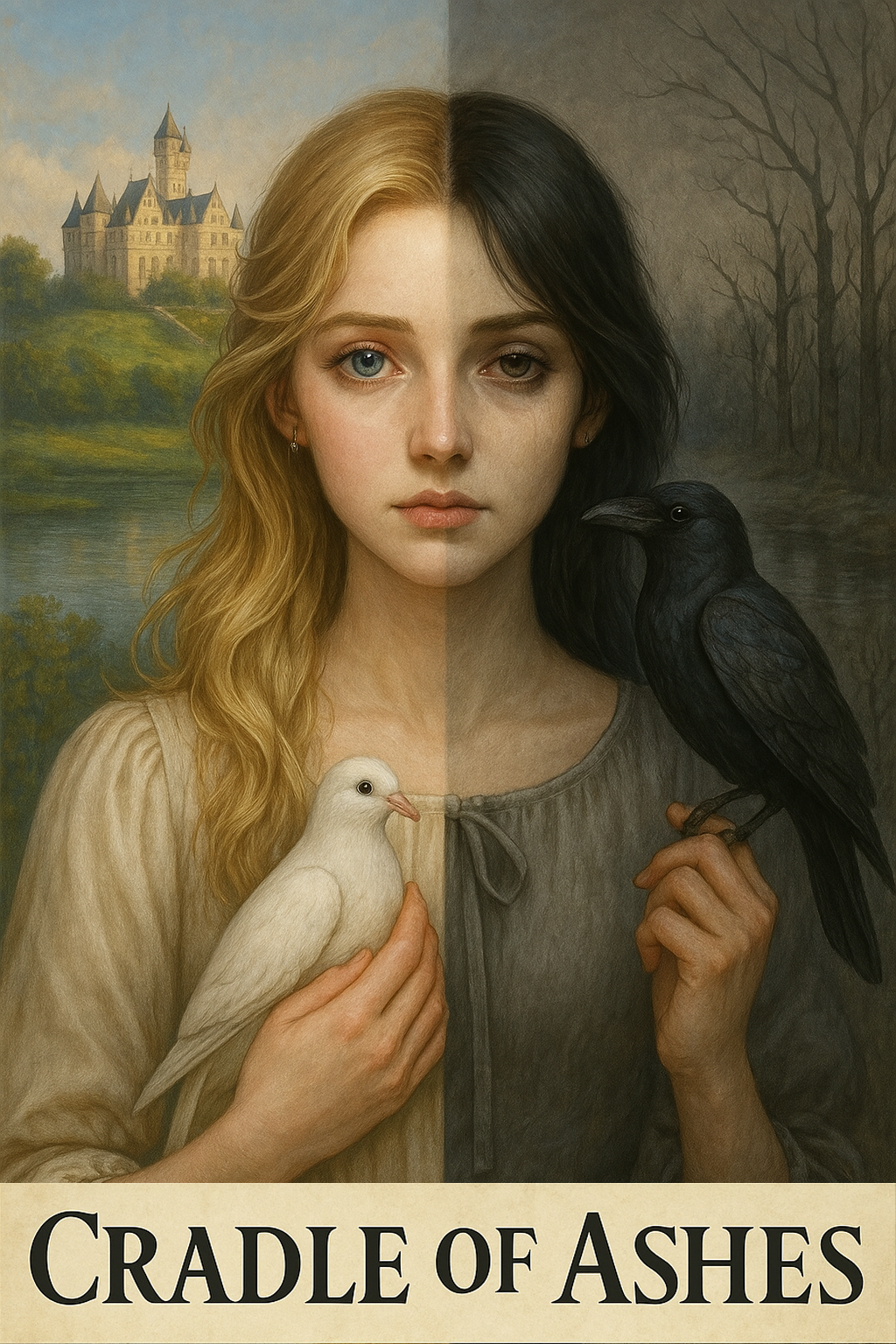
The strands were black.
Not gold.
Not the color I had known all my life.
Something moved through me, more raw than grief. I stared at my reflection in the still water and felt my hands curl into the mud. The face looking back was mine and wasn't. Gray eyes. My jaw tightened. I want to scream.
A crow called.
Sharp. Single. Close.
The sound split through me like a blade finding a seam, and whatever had been rising — stopped. The heat in my throat cooled. My hands uncurled. I became aware, slowly, of how still and cool the air was. Of the fog lying low across the water like a held breath. Of the silence between the trees.
I exhaled.
My thoughts settled the way sediment settles after a disturbance, particles falling back into their natural order. The pain behind my eyes remained, but it was now only a manageable dull.
I looked at the treeline properly for the first time.
The fog had thinned at its edges, and in the gray early dawn the forest stood in layers — trunk behind trunk behind trunk, receding into depth, each tree connected to the next by the slow family of roots I could not see. There was a logic to it. Each one drawing from the same water table, each canopy adjusting its angle to the same light, the whole structure a single organism pretending to be many. I had never thought of trees this way before. I found, distantly, that I wanted to.
The crow called again. An answer came from further off, and then another, the cries passing through the canopy in waves until the whole treeline was briefly, wildly alive with them.
Then silence.
Then the fog moved; parting slowly, deliberately, the way a curtain is drawn by a hand rather than a draft. Through the gap in the mist I saw them before I understood what I was seeing.
Green eyes.
Watching without pause.
I did not move. My breath, still ragged, betrayed me.
The past folded itself around my throat. I remembered the library, as it once was. The vows not spoken — but sold through contract. The dove, and its fragile, trusting weight in my hands.
Nothing but a token for someone else's ambition.
A lesson surfaced: Checkmate is often reserved for those with the courage to sacrifice.
He had spoken those words so easily. As if life and loss were pieces on a board.
He was right.
Beneath the green eyes, a mouth curled into a cruel smile.
I steeled myself.
No longer will I be the pawn.
Chapter 1
Windsor Manor—5 Years Earlier
The library breathes differently than the rest of the Manor.
But here—I am me.
The air smells of old wood and parchment, like a memory too heavy to lift. Dust hangs in the beams of colored light that filter through the stained-glass dome overhead, fractured into thin ribbons that cross the long tables like pieces on a game board. The sun is still low, barely cresting the southern towers.
My home within a home.
I sit in my usual place: second alcove from the door. The table is wide, polished to a dull shine, scarred faintly by decades of scholars before me.
The blueprint sprawled before me struggles to hold itself flat, the edges curling stubbornly. My elbows press down the topmost edge, the soft cotton of my sleeve bunching under the pressure. I can feel my pulse faintly in my forearm.
A trebuchet.
Not the crude ones that rely on ropes twisted in agony like some captured animal, but a proper counterweight design. Elegant. Predictable. The way the earth yields to gravity every time, without variance, without compromise.
The world outside does not work like this.
My eyes follow the arc sketched in faint black ink. A perfect curve, rising and falling in a graceful parabolic sweep. The force diagram rests to one side: mass, distance, angle, acceleration, release point... all accounted for.
I slowly trace the line with my fingertip, as if touching something alive. In a way, I am. There is life here, predictable motion captured in beautiful stillness.
Sixty degrees. Slightly steeper than most might assume optimal. But the math doesn't lie.
"Sixty."
At this angle, the weight transfers fully into the arm's acceleration, maximizing the projectile's arc, allowing for greater range—provided, of course, the sling releases at the right moment.
The word vanishes into silence.
Another faint curl along the bottom irritates me for pulling my attention.
I smooth it flat with my palm, feeling the coarse texture of the heavy vellum beneath my fingers. I can see slight ridges where the ink thickens.
The scribe pressed too hard.
Even in design so precise, the human hand leaves small imperfections.
A siege engine functions precisely as guided. The trebuchet does not protest the material of its make. A battery officer does not blame the engine for the missed placement of a projectile.
One might argue a matter of maintenance, but even that is at no fault of the subject.
Always the small imperfections.
Yet here, in these margins, the flaws are different.
Errors of mark or material I can tolerate. Those are honest flaws. Not like the errors of people. Not like the things they say. The way they laugh when they think I'm not listening. The way they speak as if I do not understand.
But I do. I always do.
Beyond the tall windows, faint voices rise and fall.
Outside these walls, everything expects something of me. The servants with their lowered gazes, waiting for orders I never give. The stewards and tutors who measure my progress against his invisible expectations.
His silent glances—always appraising—but void of praise. The empty corridors, filled with echoes of conversations that are not mine to enter.
I know how it will be someday. Polite greetings, eyes that skip me in favor of whomever I am married to. The men will speak of their exaggerated heroics and their horses. The women will whisper about dresses and engagements. No one will speak of fulcrums or torsion stress or yield thresholds.
And when I try, their smiles will stiffen.
Not my station.
I copy a formula into my notebook, careful to keep my script clear and even, careful not to press too hard, nor too soft. The graphite slides across the page without hesitation. Each symbol in its rightful place. Each calculation building toward something more.
Here, I am certain.
A lock of my hair falls across my eyes, the pale blonde strands catching the colored light. I brush it back behind my ear, annoyed at its distraction. It's grown too long again. I'll need to ask the maid to trim it soon.
I likely won't.
She'll ask questions I don't want to answer, or worse, compliment how pretty it's gotten.
Pretty.
What a useless word.
My fingers linger at my temple as I glance once more at the mechanism's release point. There's still a minor inefficiency in the sling length: the pendulum arc could be slightly smoother if weighted with distributed mass along the arm rather than concentrated at the tip.
I scribbled the revision quickly into the margin.
Another laugh echoes from the hallways beyond, breaking my focus. I exhale sharply.
The morning bell from the manor's central tower chimes the hour. Its deep, sonorous toll vibrates faintly through the marble floor beneath my feet.
I do not move.
No one is waiting for me. No one will notice if I remain here all day.
Perhaps, in time, I will simply vanish into the pages. A name etched in the margins of someone else's ledger, as forgotten as the scribes who copied these blueprints before me.
I shift my gaze upward toward the stained glass dome. The sun has risen higher now, sending sharp beams of colored light across the alcoves. Gold, green, and purple shift like floating banners across the stone walls. The beams reach the edge of my desk but never quite touch me.
I wonder if they avoid me on purpose.
It feels appropriate.
I close my notebook softly and rest my hands atop it, fingertips aligning perfectly along the cover's edge.
Order. That's all I want. The comfort of knowing where everything belongs.
Even me.
The parchment curls again.
I press it flat.
The door hinges whispered behind me. Not loud enough to startle, but present enough to fracture the stillness. I knew who it was before he spoke.
"Lady Speer."
The steward's voice was silk stretched thin over formality. Polite and measured. I let my hand remain on the blueprint a moment longer before raising my gaze.
He stood by the threshold, posture as straight as the hall's carved pillars. His uniform held the Windsor crest: a golden falcon upon white, but without the flare of nobility.
"Good morning, Ser Diener," I offered.
He glanced briefly toward the table, eyes flickering over the array of notes, calculations, and the wide blueprint that still resisted my efforts to keep it flat. A small, almost invisible smile pressed at the corner of his mouth. Not unkind, more... amused.
"I came to ensure all was well, Lady Speer. The late-morning bell has rung." His words paused at the edges, inviting response. "You've missed breakfast, m'Lady."
I took a small breath. "I apologize, Ser. I… got distracted..."
"Of course," he said with the tone adults use when speaking to children.
"Your father asked after you."
I kept my expression composed. I shifted slightly in my chair, folding my hands atop my closed notebook, as though arranging a defensive line of soldiers across my chest. My tone remained gentle. "Please give him my apologies, Ser."
"I shall, m'Lady."
His eyes wandered back to the blueprint, this time allowing themselves a few seconds of true study. The trebuchet's arching release curve cut clean across the vellum like a falcon striking its prey midflight. His eyebrow twitched as he saw my annotations filling the margins.
"You've a curious interest for a girl your age."
I didn't answer right away.
The air between us softened, but only slightly. He hadn't meant it cruelly. Just the statement. Observational. Honest, in its way, but still a reminder.
"You've a curious interest in my interests, Ser," I said, with a slight curl on my lips.
Diener's head inclined.
"A poetic answer, m'Lady."
His eyes lingered for another moment before withdrawing politely. "Shall I inform the kitchen to prepare a plate, should you feel hungry later?"
"No. Thank you, Ser."
"As you wish."
With a small bow, he turned toward the door and pushed against it.
The heavy oak didn't move.
"It pulls," I said flatly, not moving from my seat.
"Naturally." Diener whispered, pulling the iron handle with smooth correction. "Thank you, m'Lady."
The door closed behind him, restoring the library's breathless quiet.
You've a curious interest for a girl your age.
I turned back to the blueprint. My focus wavered now, the formula's certainty dulled by the reminder.
Not because I disagreed. I knew I was different.
Because I had hoped, perhaps, they would stop noticing.







This is haunting in the most elegant way ,the lake opening feels like a rebirth wrapped in grief, and the pawn metaphor is devastatingly sharp. The contrast between the cold, calculating precision of the library and the raw ache of the shoreline is beautifully controlled. You don’t just write scenes, you build atmospheres that linger long after the page ends. Truly, this feels like the beginning of something unforgettable.