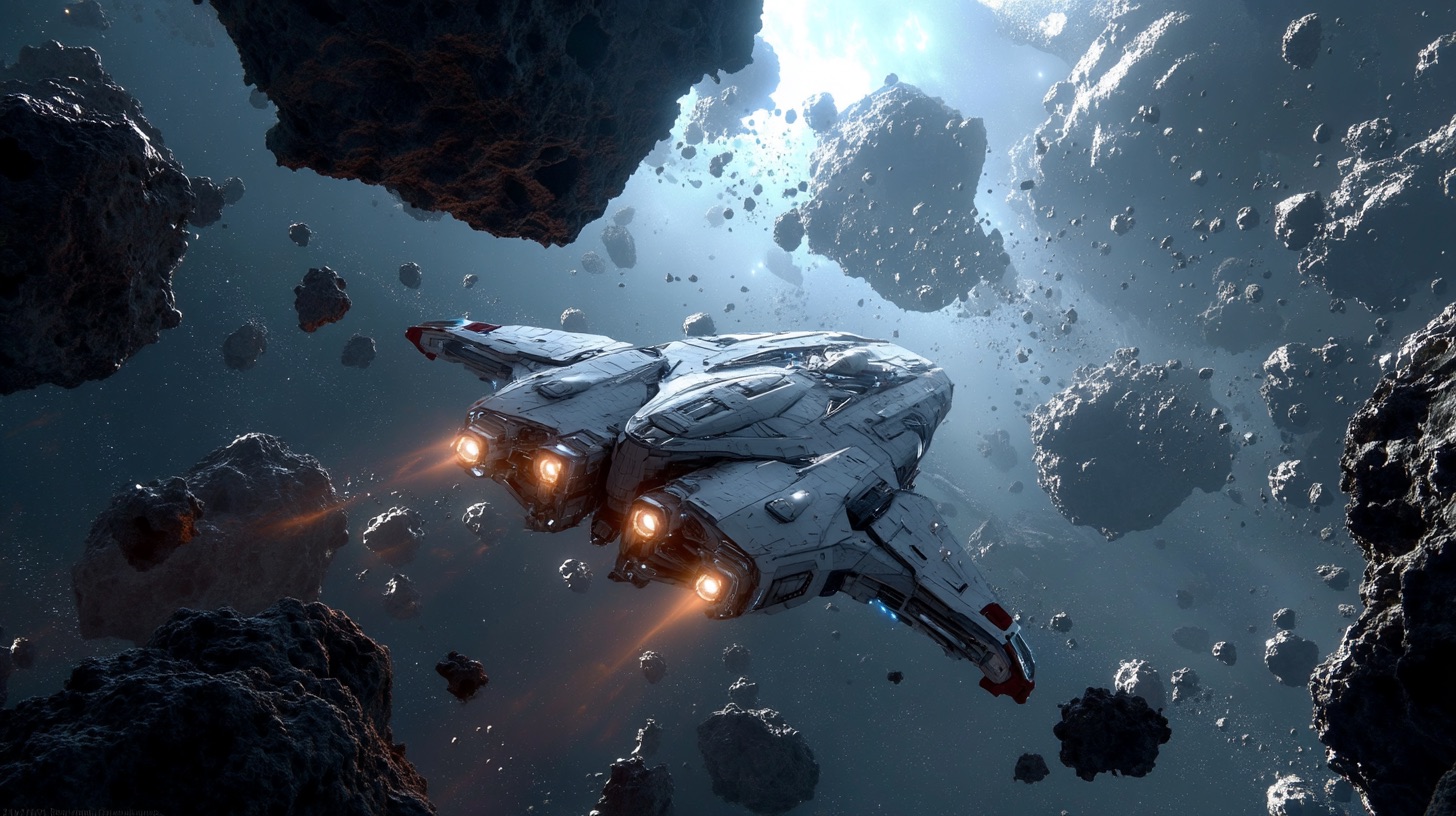
W.E.V. Ascendant
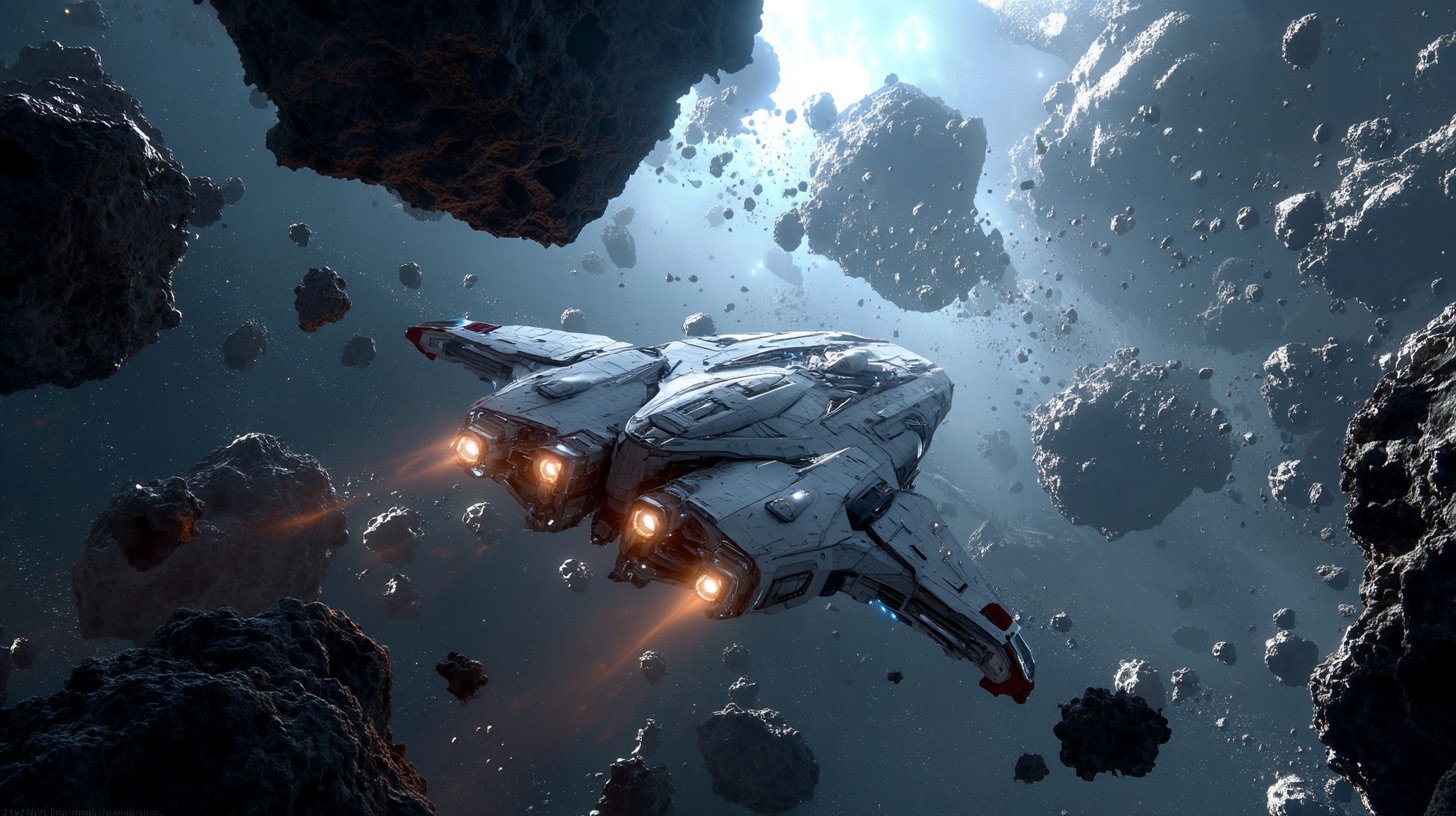
The Destroyer W.E.V. Ascendant is the jewel of WayCorp's fleet. First of its class it is a deep space exploration vessel, highly automated to minimize the crew requirements and equipped with possibly the best to date sensors array and equipment that makes it the perfect survey vessel.
Development started at 1082 AFL the prototype ship will get its maiden voyage in early 1087 AFL from Glise Star System's WayCorp HQ to Outpost Milliways in the Douglas Star System
W.E.V. Ascendant
The W.E.V. Ascendant is a Ascendant-Class Exploration Vessel (Destroyer Chassis) operated by WayCorp Exploration Division. Commissioned in 1087 AFL, the vessel represents the latest generation of deep-space exploration technology and serves as a flagship example of WayCorp’s commitment to pushing the boundaries of known space.
Constructed at the orbital shipyards of Glise and equipped with an experimental long-range sensor suite and next-generation StarDrive technology, the Ascendant was designed specifically for extended exploration missions beyond the established frontier. The vessel’s maiden voyage marked the beginning of a new era in WayCorp’s exploration efforts, carrying a hand-picked crew into the unknown reaches beyond civilized space.
The ship’s motto, engraved above the main bridge viewport, reads:
“Into Darkness, Seeking truth.”
The Ascendant was conceived following a series of discoveries made by WayCorp survey expeditions operating near the edge of charted space. New stellar anomalies, unidentified energy signatures, and reports of ancient alien ruins convinced WayCorp leadership that a dedicated deep-space exploration platform was required.
Rather than adapting an existing military or commercial design, WayCorp engineers developed an entirely new vessel centered around exploration. Every aspect of the ship—from its sensor arrays to its scientific laboratories—was optimized for discovery and investigation.
The Ascendant features a sleek, elongated hull profile optimized for long-duration operations and sensor efficiency. Unlike military destroyers, which prioritize armor and weapons systems, the Ascendant sacrifices some Combat capability in favor of expanded scientific facilities and advanced scanning equipment.
Its most distinctive feature is the massive dorsal sensor spine running nearly the entire length of the vessel. This structure houses thousands of individual sensor elements capable of detecting faint energy emissions across vast interstellar distances.
The ship’s hull is finished in WayCorp’s signature white-and-red exploration livery, making it immediately recognizable throughout corporate space.
Propulsion
Star Rise Drive Mk VII
The Ascendant is among the first vessels equipped with the Star Rise Drive Mk VII, a revolutionary advancement in faster-than-light travel.
The new drive offers:
- Increased jump accuracy
- Reduced transit times
- Improved fuel efficiency
- Enhanced safety margins during long-range operations
- Greater resistance to gravitational interference
This technology allows the vessel to reach regions previously considered impractical or dangerous for routine exploration.
Sublight Engines
A cluster of four high-efficiency Induction engines provides maneuvering capability within star systems.
Exploration Systems
Deep Scan Array
The vessel’s primary mission equipment is the WayCorp Deep Survey Array, one of the most sophisticated sensor platforms ever constructed.
Capabilities include:
- Planetary composition analysis
- Subsurface geological scanning
- Energy signature tracking
- Long-range stellar observation
- Artificial structure identification
- Gravitational mapping
The system is specifically designed to identify evidence of ancient civilizations and previously unknown phenomena.
Scientific Facilities
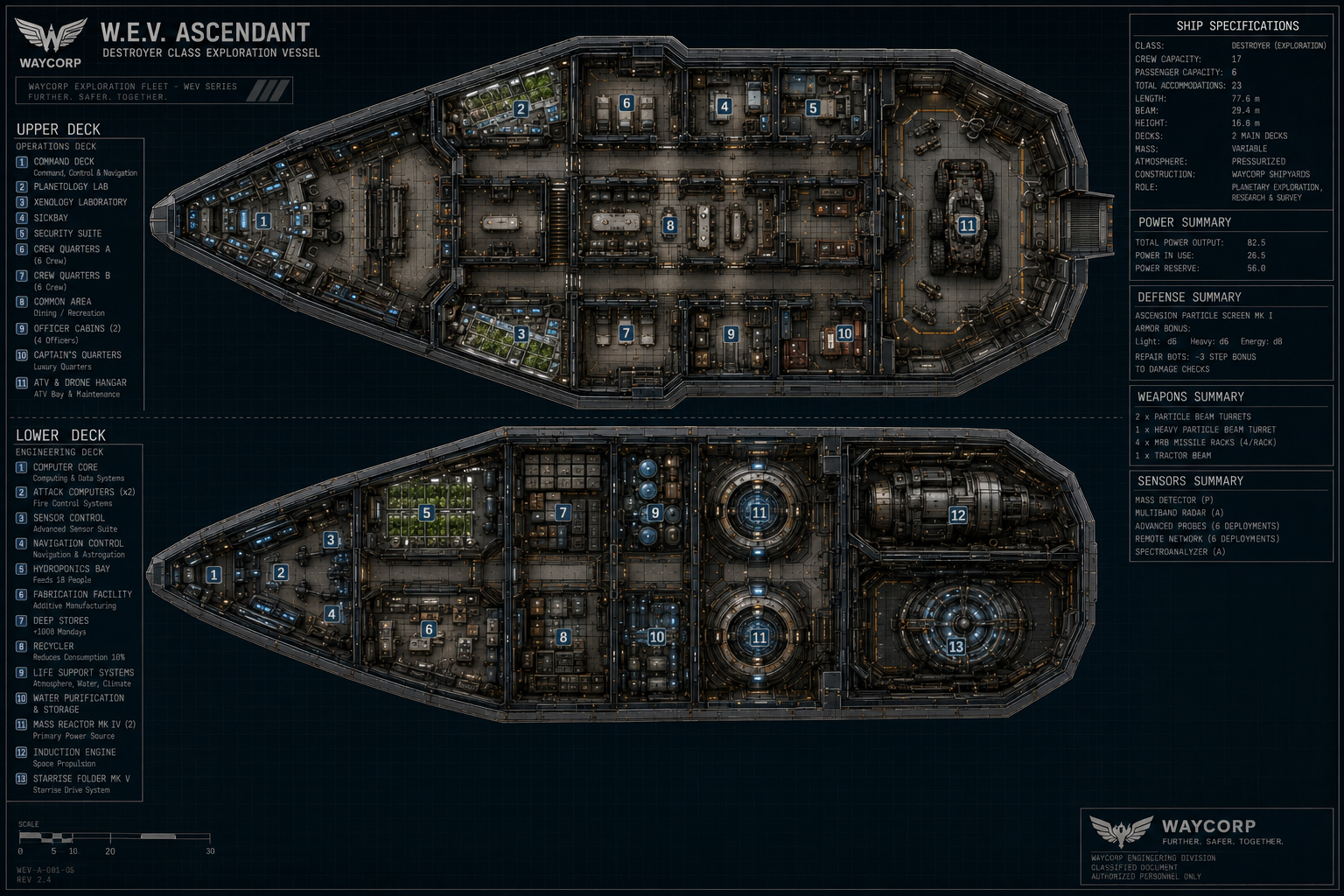
Unlike military destroyers of comparable size, the Ascendant devotes a significant percentage of its internal volume to scientific operations. The vessel was designed from the keel up as a deep-space exploration platform capable of supporting long-duration survey missions beyond the established frontier.
The scientific complex occupies much of Deck 3 and includes dedicated laboratories, sample storage facilities, environmental containment chambers, survey planning rooms, and research workstations. Scientific personnel are able to process, analyze, and archive discoveries without relying on external facilities, allowing the ship to remain operational for extended periods in unexplored regions of space.
The facilities are specifically optimized for the study of ancient ruins, alien ecosystems, planetary geology, and anomalous phenomena.
Xenology Laboratory
The Xenology Laboratory serves as the primary research facility for biological and archaeological discoveries recovered during exploration missions.
The laboratory contains multiple containment suites, sterile examination rooms, genetic sequencing equipment, environmental simulation chambers, and secure artifact storage vaults. These facilities allow scientists to safely study unknown lifeforms, biological samples, and recovered relics from ancient civilizations.
Under the supervision of Dr. Elias Finch and Biologist Suri Patel, the laboratory frequently becomes one of the busiest locations aboard the vessel following a planetary survey or archaeological expedition.
Many of the Ascendant’s most valuable discoveries are expected to pass through the Xenology Laboratory before being transferred to WayCorp research archives.
Planetary Sciences
The Planetary Sciences Department is responsible for the analysis and classification of newly discovered worlds.
Utilizing advanced geological scanners, atmospheric analysis systems, mineral processing equipment, and planetary simulation software, the department can rapidly assess the habitability, resource potential, and scientific value of surveyed planets.
Led by Geologist Theo Mercer, the department works closely with the ship’s sensor division to create detailed planetary profiles and identify promising exploration targets.
The department’s data forms the foundation of WayCorp’s expanding stellar cartography database and helps guide future exploration efforts throughout the frontier.
Defensive Systems
Operating far beyond the protection of established authorities requires a vessel capable of surviving unexpected dangers. While the Ascendant is fundamentally an exploration ship, it possesses a robust defensive package designed to protect both crew and mission from pirates, hostile vessels, and environmental hazards.
Protection begins with a medium Neutronite armor shell reinforced by an Ascension Particle Screen generator. Together these systems provide layered protection against kinetic impacts, energy weapons, and high-energy stellar phenomena. Internal damage control is further supported by a network of autonomous repair drones capable of rapidly identifying and mitigating hull damage during combat or emergencies.
The vessel’s defensive systems are overseen from the bridge by the Weapon Systems Specialist and supported by advanced targeting computers and sensor integration. Although not intended for front-line military operations, the Ascendant is more than capable of defending itself when necessary.
Armament
The Ascendant’s primary armament consists of a pair of Particle Beam Turrets and a centrally mounted Heavy Particle Beam Turret. These weapons provide accurate long-range firepower capable of engaging hostile spacecraft, disabling targets, or protecting the ship during dangerous encounters.
For long-range heavy defense, the vessel carries a four-cell Missile Rack capable of deploying guided ordnance against enemy ships or incoming threats. The missile system provides flexibility when confronting fast-moving or heavily armored opponents.
A dedicated Tractor Beam system allows the crew to secure cargo, recover disabled vessels, manipulate debris, or prevent smaller craft from escaping. While not technically a weapon, it has proven invaluable during both exploration and combat operations.
Combined with dual attack computers and advanced sensor systems, the Ascendant possesses enough firepower to discourage most opportunistic threats encountered on the frontier.
Crew Facilities
The Ascendant was designed to support a crew of eighteen personnel during extended missions far from resupply points. Every compartment serves multiple purposes, balancing comfort, efficiency, and operational necessity within the vessel’s limited internal volume.
The Captain occupies dedicated luxury quarters while senior officers are housed in two shared officer cabins. The remainder of the crew are accommodated in a pair of crew berthing sections capable of supporting twelve personnel. Though compact, the accommodations provide sufficient privacy and comfort for long-duration deployments.
Life support is supplemented by a Hydroponics Bay capable of producing fresh food for the entire crew, reducing dependence on stored rations while improving morale during lengthy voyages. Deep Stores provide sufficient provisions for thousands of man-days of operation, while an advanced recycling system dramatically reduces consumption requirements and extends mission endurance.
Additional facilities include a fully equipped Sickbay, a Security Suite for the vessel’s security personnel, and a Fabrication Facility capable of manufacturing replacement components, tools, and mission-critical equipment. Together, these systems allow the Ascendant to operate independently for extended periods beyond the frontier.
A small cargo hold, drone facilities, ATV hangar, and emergency escape pod complete the vessel’s support infrastructure, ensuring the crew remains prepared for exploration, survival, and unexpected emergencies alike.
Notable Features
Memorial Wall
A tradition carried over from earlier exploration ships, the Memorial Wall records the names of explorers who lost their lives expanding humanity’s knowledge of the galaxy.
The Pioneer Bell
A ceremonial bell salvaged from one of WayCorp’s earliest exploration vessels. It is rung whenever the Ascendant enters an uncharted star system for the first time.
Mission Profile
The Ascendant’s operational mandate includes:
- Exploration of uncharted space
- Discovery of new star systems
- Investigation of alien ruins
- Hazard assessment
- Frontier cartography
- Deep-space reconnaissance
The vessel is expected to spend the majority of its service life operating beyond the established borders of The Reach.
W.E.V. Ascendant Ship Sheet
+176hp
| Hull Type | Hull Points | Toughness / Target | Maneuver |
|---|---|---|---|
| Destroyer, Advanced | +176 (160+16) 5%: 8 10%: 16 | Light / +1 | 3 + 1 (Stabilizers) |
Command, Control, Comms
-6.5hp Pow: 0 / 2
| Name | Hull | Power | |
|---|---|---|---|
| Command Deck | 2 | 0 | Captain, Pilot, Weapons, Sensors, Defenses, Engineering |
| Mass Transceiver | 1 | 1 | |
| Radio Transceiver | 0 | 0 | Disassembled |
| Laser Tranceiver | 0 | 0 | Disassembled |
| Computer Core, Good | 1 | 1 | |
| Sensor Control, Good | 1 | 0 | -2 step bonus to dedicated sensor |
| Nav Control, Good | 1 | 0 | -2 step bonus to Maneuver checks |
| Attack Computer x2 | 0.5 | 0 | -1 step bonus to attack rolls |
Power Plant
24hp +90pow
| Name | Hull | Power Output | |
|---|---|---|---|
| Mass Reactor Mk IV x2 | 24 | 90 (3.75 / hull) |
Propulsion
40hp Power: Space: 32 | Starrise: 24 (+10 / LY)
Base StarRise 10 LY + 60 Pow = 16 LY
Jump time: 121 Hours
Jump Rest: 60.5 Hours
=> 16 LY / 7.5 Days
| Name | Hull | Power | Accel. Rating |
|---|---|---|---|
| Induction Engine | 20% (32) | 32 | 4 |
| StarRise Drive Mk V | 5% (8) | Min: 24 (+10 Power / LY) | 10 LY + |
| Folder Component | 4 | 10 |
Support
11hp Power: 2 / 5
| CName | Hull | Power | Notes |
|---|---|---|---|
| Auto Support | 2 | 2 | 80 out of 176 Hull Points Covered |
| Captain's Quarters | 1 | 0 | Captain's Luxury Quarters |
| Officer Cabin x2 | 1 | 0 | 4 (2x) Officers Total |
| Crew Quarters x2 | 2 | 0 | 12 Crewmen Total |
| Hydroponics Bay | 3 | 2 | Feeds 18 people |
| Deep Stores | 1 | 0 | +1000 Mandays |
| Recycler | 1 | 1 | Reduces consumption to 10% |
Armor & Defense
18hp | Power: 0 / 12
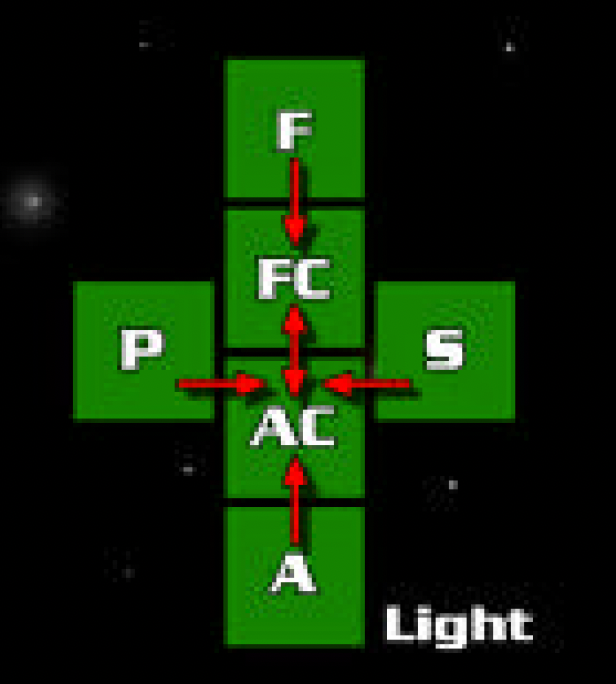
Compartments
F (Forward)
FC (Forward Center)
AC (After Center)
A (Aft)
P (Port)
S (Starboard)
| Stun | Wound | Mortal | Critical |
|---|---|---|---|
| 40 | 40 | 20 | 10 |
Armor
| Armor Name | Hull | LI | HI | EN |
|---|---|---|---|---|
| Neutronite, Medium | 5% (8) | d6+1 | d6+1 | d6+1 |
Defenses
| Hull | Power | Notes | |
|---|---|---|---|
| Ascension Ablative Screen Mk I | 1 | 16 | Adds d6(LI), d6 (HI), d8 (En) armor |
| -- Ablative Shield Capacitor | 3 | 30 Shield Points | |
| Repair Bots | 5% (8) | 8 | -3 step bonus to Damage Checks |
| Chaff (1 Shot) | 1 | 0 | |
| Jammer | 1 | 2 | |
| Decoy Drone | 1 | 0 |
Weaponry
22hp | Power: 0 / 24
| Name | Hull | Power | Firepower | Accuracy | Range | Damage | Mode |
|---|---|---|---|---|---|---|---|
| Particle Beam Turrets x2 | 5 (10) | 5 (10) | En/S | -2 (-4) | 2/4/6 | d6+3s/d4+1m/d4+3m | F |
| Heavy Particle Beam Turret | 16 | 16 | En/L | -1 (-3) | 2/4/6 | d12+3s/d6+1m/d6+3m | F |
| MRB Missle Rack (4) 4/r | 2 | 1 | En/M | 0 | *** | 2d4+1s/2d4w/d8+1m | - |
| Tractor Beam | 2 | 5 | Special | 0 | 2/4/8 | Special | |
| Point Defense Cannon x2 | 2 | 0 | Hi/Gd | -1 | 1/2/3 | d4s/d4w/d4+2w | F/B/A - 4 pcs 30rnds each |
Sensors
5.5hp | Power: 0 / 5
| Name | Hull | Power | Type | Range | Arcs |
|---|---|---|---|---|---|
| Mass Detector | 4 | 4 | Passive | 10/30/50 | 4 |
| Multiband Radar | 2 | 4 | Active | 10/20/40 | 4 |
| Advanced Probes | 1 | 0 | Remote | - | |
| Remote Network | 2 | 2 | Remote | (6 Deployments) | - |
| Spectroanalyzer | 1 | 1 | Active | Planet: 1/5/25 AUs / Ships:2/4/16 Mm | 1 |
| Deep Scan Array | 4 | 10 | Special | Doubles all other | * |
Hangars & Utilities
20hp | Power: 0 / 4
| Name | Hull | Power | Notes |
|---|---|---|---|
| Cargo Hold | 3 | 0 | 100m3 |
| Escape Pod | 1 | 0 | 10 People |
| Lab, Planetology | 2 | 0 | |
| Lab, Xenology Laboratory | 2 | 0 | |
| Sickbay | 2 | 0 | |
| Fabrication Facility | 4 | 2 | |
| Security Suite | 2 | 2 | Main Deck Only |
| Stabilizers | 5% (8) | 0 | |
| Hangar | 10 | 0 | ATV & Drone Hangar |
Equipment on Board
Power Management
Produced: 90
Hyperspace: 9 + 24 (33) + 10 / Additional LY
Combat: 88
Adrift: 3 (Autosupport + Core)
Crew
Captain Daisy "The Captain" Palmer
Executive Officer Charlie Taylor
Pilot Shallan Mercer
Bridge
Sensors River Doyle
Communications Marcus Kane
Weapon Systems Specialist Kyra Leipzig
Engineering Department
Master Chief Ripley Racker
Reactor Tech Jax Merrick
Systems Technician Ava Serrano
Security
Security Specialist Gideon Cross
Security Specialist Niko Reyes
Science Dept.
Archeologist Dr. Elias Finch
Biologist Suri Patel
Planetologist Willow Haywood
Medical
Doctor Lasya
Assistant Felix Arden
Operations & Logistics
Quartermaster Helen Ward
Spacehand Owen Briggs
Rebecca the Medical Bay Cleaning Drone


Comments